You moisturise every day, yet your skin still looks a little uneven. Your skin feels soft, but perhaps it does not have the same bounce it used to. Or you notice a fresh glow after a facial, while fine lines remain visible.
How can these things happen at the same time?
Because skin quality has several different parts. Hydration, texture, elasticity and density are connected, but each describes something different about your skin.
Understanding these terms can make skincare labels and treatment menus much easier to navigate. More importantly, it helps you put into words what you would actually like to improve.
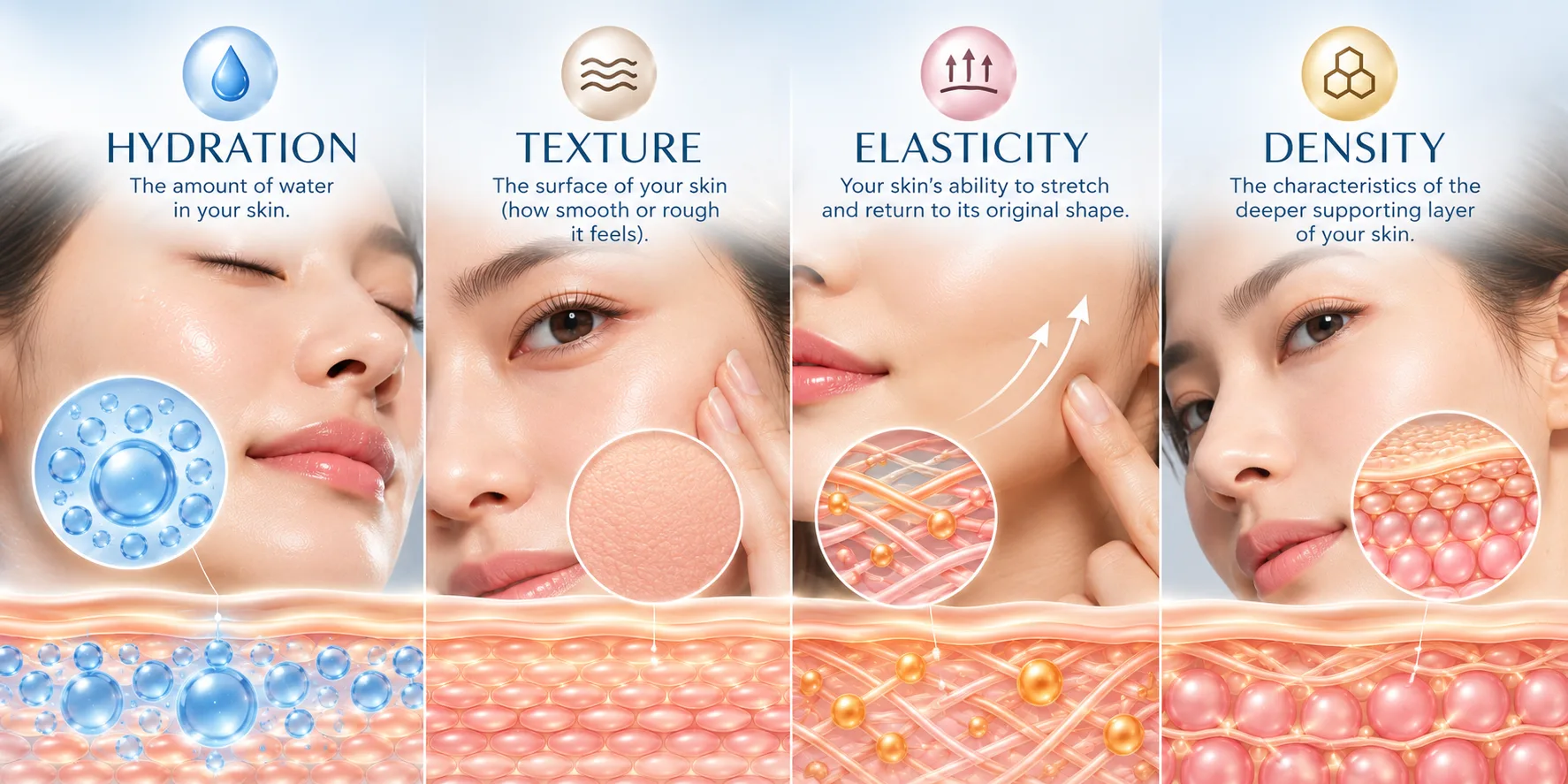
Hydration: How Well Your Skin Holds Moisture
Hydration refers to the water content of your skin. When the outer layer has enough moisture, skin generally feels softer, more comfortable and less rough.
When it lacks water, you may notice tightness, a dull appearance or fine surface lines that look more obvious.
Think of a sponge. When it contains water, it feels softer and more flexible. When it dries out, its surface becomes less supple. Your skin is far more complex, but the comparison helps explain why moisture makes a difference to how it looks and feels.

Dehydrated skin and dry skin are not exactly the same. Dry skin generally lacks oil, while dehydration refers to insufficient water. You can have oily skin that also feels dehydrated.
Hydration is an important part of healthy-looking skin. However, well-hydrated skin can still have visible pores, scars or reduced firmness.
In everyday language: “My skin feels tight, and I want it to feel more comfortable and moisturised.”
Texture: How Smooth or Uneven Your Skin Looks and Feels
Texture describes the surface of your skin.
Smooth texture feels relatively even when you gently run your fingers across it. Uneven texture may involve rough patches, bumps, visible pores, fine lines or acne scars.
Imagine two pieces of fabric. Both can hold moisture, but one may have a smooth finish while the other has a more noticeable weave. In a similar way, your skin can be hydrated and still have an uneven surface.
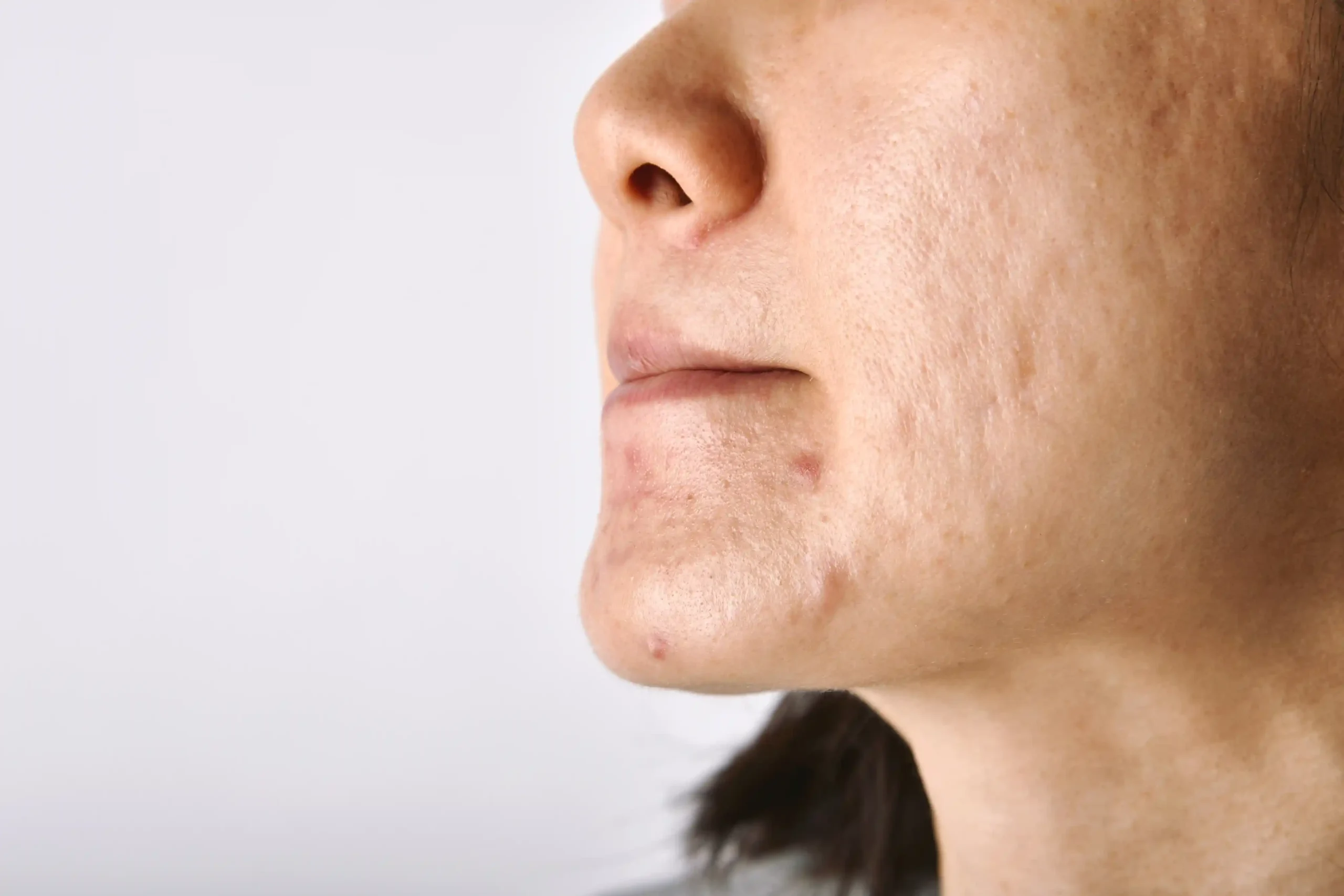
This explains why applying more moisturiser does not necessarily resolve every texture concern. Moisture may soften roughness related to dryness, but a raised bump and an indented acne scar are different issues.
Also, real skin has texture. Pores and small surface variations are normal. The poreless finish we see online often involves lighting, makeup, filters or editing.
In everyday language: “My skin feels moisturised, but I would like its surface to look smoother.”
Elasticity: Your Skin’s Ability to Spring Back
Elasticity describes how well skin returns towards its original shape after being stretched or moved.
A useful comparison is a stretchy fabric. Its flexibility allows it to move, while its ability to recover helps it return to shape.
Within the skin, elastin contributes to stretch and recoil, while collagen and the surrounding tissue provide support.
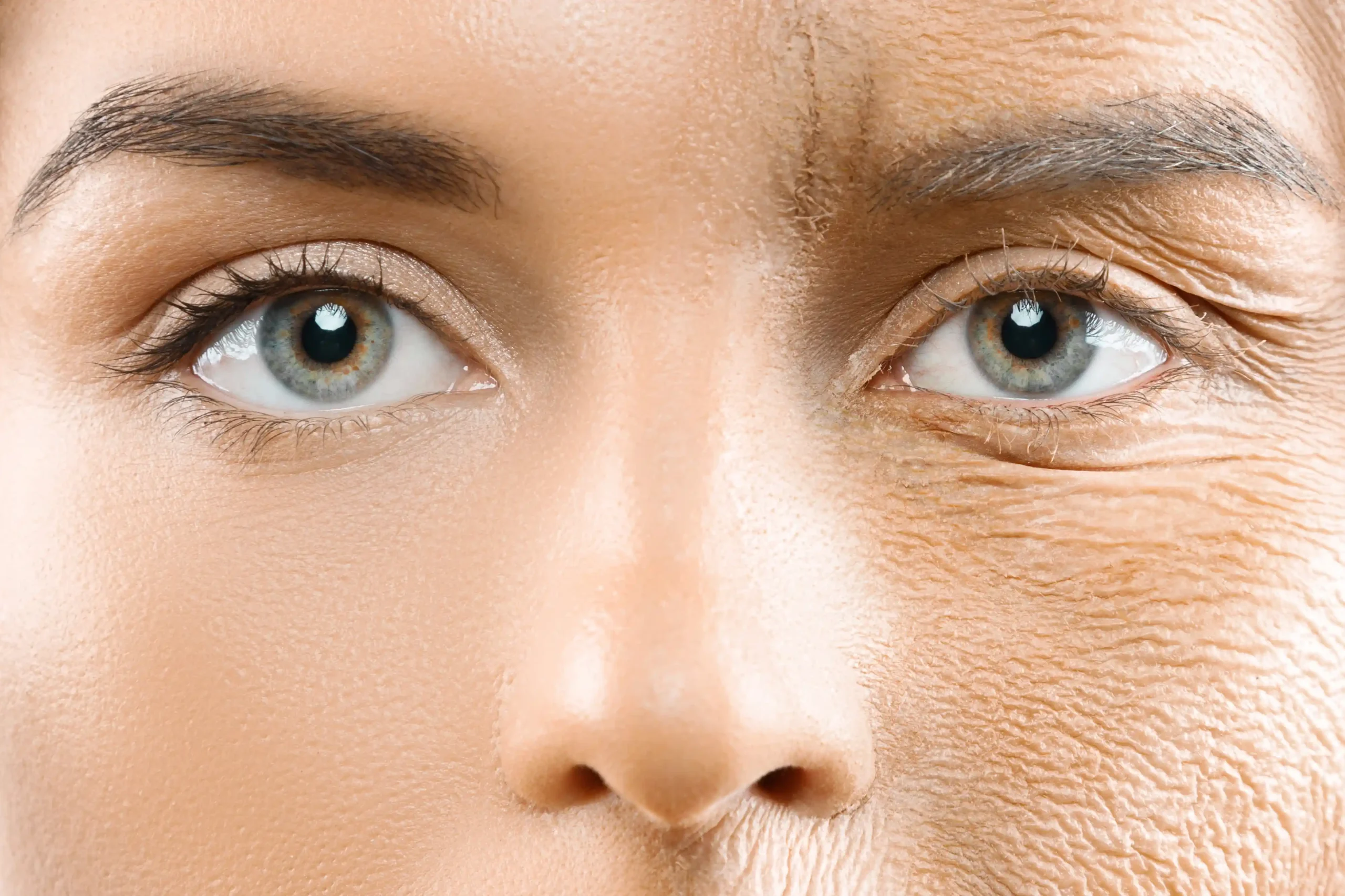
As skin changes with age and sun exposure, its ability to spring back can change too. You may notice that certain areas look less supple or develop a more crepey appearance.
However, elasticity and facial lifting are not interchangeable. Facial sagging can also involve changes in fat, supporting tissues and bone. Improving one aspect of skin quality may not address all those changes.
In everyday language: “My skin does not seem to have the same bounce it used to.”
Density: The Structure Within the Skin
Density is the least familiar of these four terms—and one of the easiest to misunderstand.
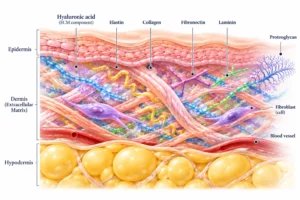
In aesthetic discussions, dermal density generally refers to characteristics of the deeper supporting layer of skin. That layer contains collagen, elastin and other components of the extracellular matrix, the network surrounding skin cells.
Think of the difference between a loosely woven fabric and one with a more substantial internal structure. The comparison gives a sense of support, although skin density is more complex than how tightly its fibres are packed.
In clinical studies, density may be assessed using imaging equipment. The exact meaning of an improvement depends on the instrument and measurement used.
Density is not the same as thickness, facial fullness or hydration. A fuller-looking cheek does not automatically mean denser skin, and a glowing photograph cannot confirm an increase in dermal density.
In everyday language: “I want to understand the support within my skin, beyond how the surface looks.”
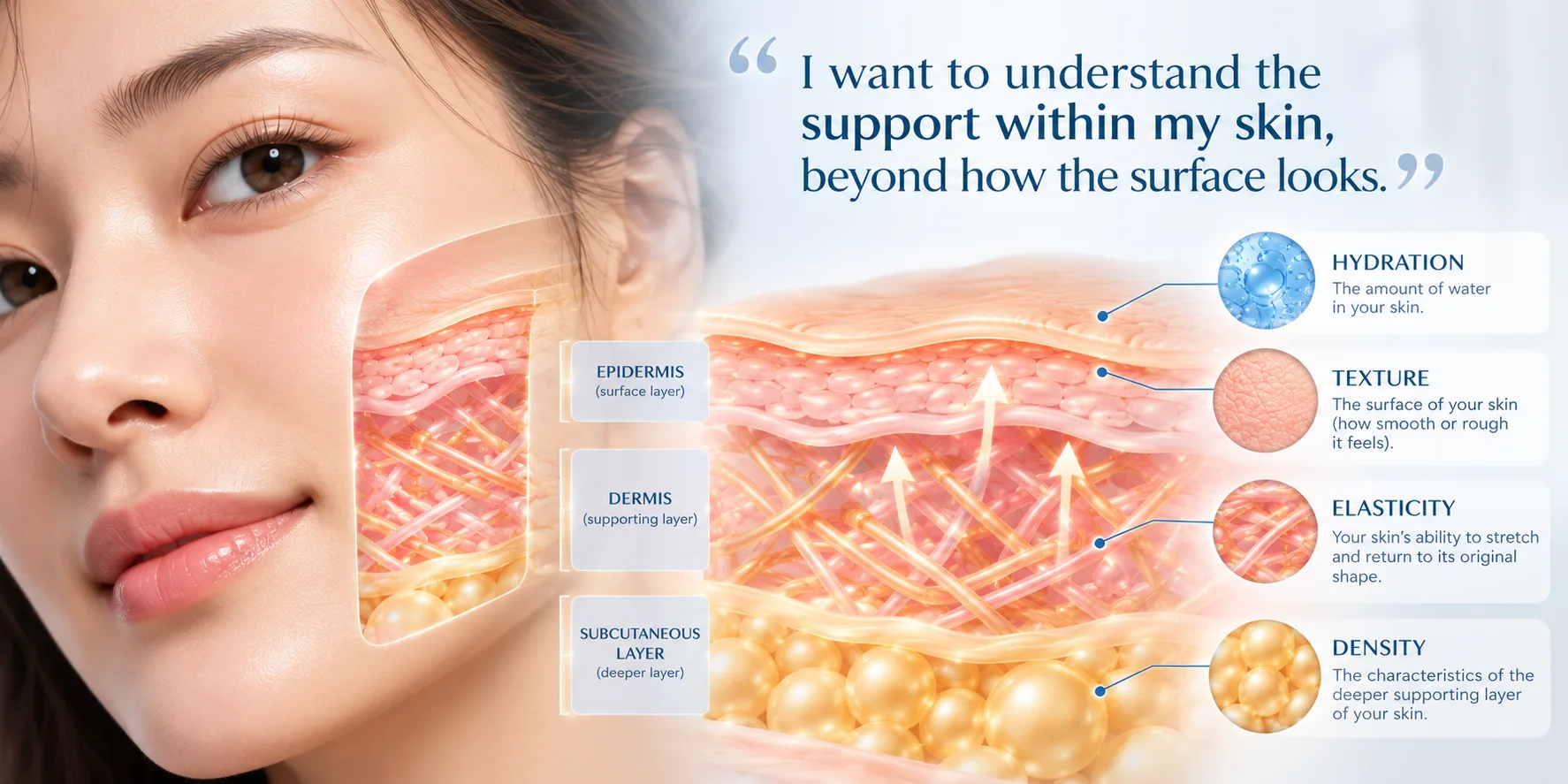
A Quick Comparison
| Aspect | What it describes | A simple way to remember it |
|---|---|---|
| Hydration | Water content | Moisture |
| Texture | Surface smoothness and unevenness | Finish |
| Elasticity | Ability to stretch and recover | Bounce |
| Density | Measured characteristics of the skin’s internal structure | Support |
Why Can One Improve While Another Stays the Same?
These qualities influence each other, but they do not always change together.
Improved hydration may make the surface look smoother without changing an acne scar. A treatment may improve a texture measurement without producing a noticeable lifting effect. Skin can also look luminous while still having reduced elasticity.
This matters when reading treatment claims. “Improves skin quality” is a starting point, but it does not tell you exactly what improves—or by how much.

Start With What You Notice About Your Skin
You do not need to diagnose your own skin before a consultation. Simply describe what you experience.
“My skin feels tight after washing.”
“My makeup catches on rough patches.”
“I have small indentations left by acne.”
“The skin around my eyes looks more crepey.”
These observations are more useful than asking for a treatment simply because it is new or popular. They help a qualified practitioner identify what may be contributing to your concern and explain which options are appropriate.
Knowing the difference between moisture, surface smoothness, bounce and internal support gives you a clearer way to talk about your skin—and more realistic expectations about what skincare or a treatment might change.